
Articles
Executive Functioning and ADHD
Executive functioning refers to mental skills that help us focus, manage, adapt, control responses, and work toward a goal.
Learn More
If your child needs extra support at school, you may hear terms such as Student Learning Plan (SLP) or Individual Education Plan (IEP).
It can be confusing, especially because not every student who needs support will have an SLP or an IEP.
Here are the basics BC parents should know.
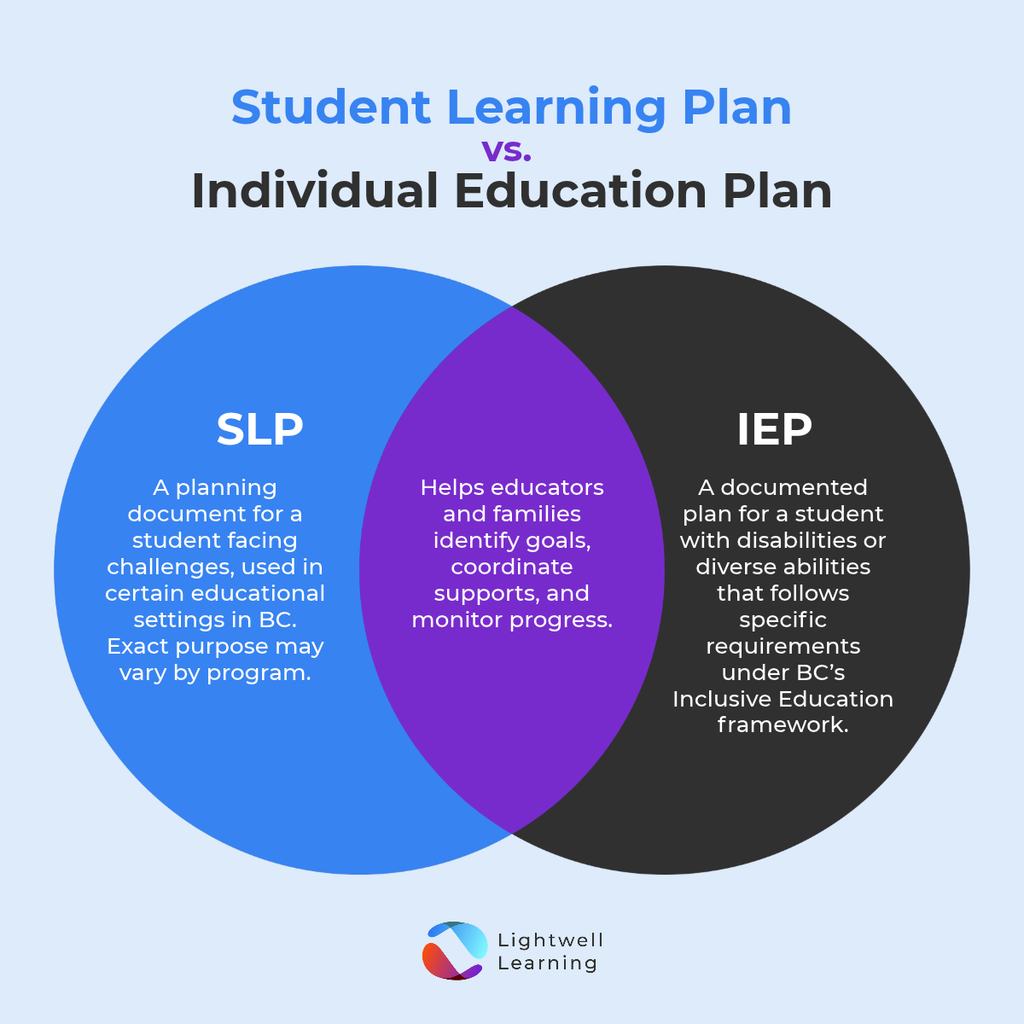
A Student Learning Plan (SLP) is a planning document used in certain educational programs and settings in BC.
For example, some online and hybrid learning programs use SLPs to outline a student’s learning goals, courses, resources, activities, and progress. BC’s Alternate Education Program policy also requires students to have an annually reviewed IEP or Student Learning Plan that identifies objectives, additional services when required, progress, and transition plans.
However, an SLP is not a province-wide plan that every student receives when they begin struggling at school. How the term is used may depend on the school, district, or educational program.
If your school tells you that your child needs a “learning plan,” ask what type of plan it is and what it will be used for.
It can, depending on the program and purpose of the plan.
For example, a learning plan may include goals or supports related to behaviour, emotional regulation, participation, or transitions.
However, having behavioural challenges does not automatically mean a child should receive an SLP. Schools can provide many types of classroom, behavioural, learning, and social-emotional supports without an SLP or IEP.
An Individual Education Plan (IEP) is a documented plan used within BC’s Inclusive Education system for students with disabilities or diverse abilities* who require individualized educational planning.
Depending on the child, an IEP may include:
Parents are important participants in the IEP process and should have opportunities to contribute information about their child’s strengths, needs, goals, and supports.
| Student Learning Plan (SLP) | Individual Education Plan (IEP) |
| Used in certain BC programs or educational settings | Part of BC’s Inclusive Education framework |
| A disability or diagnosis is not required | Used for students with disabilities or diverse abilities* who require individualized educational planning |
| May include learning, behavioural, social-emotional or transition goals depending on the program | May include academic, behavioural, social-emotional, communication, independence and other individualized goals |
| May connect goals, activities and resources to the BC Curriculum | May include adaptations, supports, services and individualized goals |
| Its exact purpose may vary by program | Has specific requirements under BC’s Inclusive Education framework |
| Does not automatically mean modified curriculum | Does not automatically mean modified curriculum |
Both can help educators and families identify goals, coordinate supports and monitor a student’s progress. Both should focus not only on areas where a student needs support, but also on their strengths and what helps them succeed.
No.
This is an important distinction for parents.
Many students with IEPs continue working toward the same BC Curriculum learning standards as their peers, but receive adaptations that help them access learning.
These might include additional time, assistive technology, audiobooks, visual supports, different instructional strategies, or alternative ways of demonstrating learning.
A modified program is different. In BC, modification means that a student’s learning standards are substantially different from the prescribed curriculum and are specifically selected to meet their individual needs.
IEP does not automatically mean a modified curriculum.
Your child does not necessarily need an SLP or IEP to receive support.
Schools can provide classroom strategies, differentiated instruction, targeted interventions, learning assistance, behavioural or regulation supports, and other accommodations based on a student’s needs.
If you are concerned, start a conversation with your child’s teacher or school team.
Consider asking:
The terminology can vary between schools, districts, and programs.
If someone tells you, “We’re creating a learning plan for your child,” don’t be afraid to ask:
“What kind of plan is this, what will it help my child with, and how will we know if it’s working?”
Parents do not need to know every acronym in BC’s education system to advocate for their child.
What matters most is understanding what your child needs, what support they are receiving, what goals everyone is working toward, and whether those supports are helping them succeed.
— Sofia Lopez Nakashima, Senior Manager, Assessments
We are a community of dedicated professionals who write collaboratively. We recognize the contribution of unnamed team members for their wisdom and input.
*As a neuroaffirming organization, we prefer not to use these terms at Lightwell Learning. However, these are the exact terms used by the province of British Columbia.
Receive our bi-weekly Arise newseltter which includes resources, updates, stories, events, and more.
Executive functioning refers to mental skills that help us focus, manage, adapt, control responses, and work toward a goal.
Learn More
English Language Learning, commonly called ELL, refers to supports and services for students who are developing the English-language skills needed to participate successfully in school.
Learn More
Our name is changing. The people, expertise, programs, and commitment behind our work are not.
On September 2, 2026, Learn. Develop. Succeed. becomes Lightwell Learning.