
Articles
Executive Functioning and ADHD
Executive functioning refers to mental skills that help us focus, manage, adapt, control responses, and work toward a goal.
Learn More
What we cannot see still matters.
When we think about disability, we often picture a wheelchair, mobility aid, or service animal. However, many disabilities are not immediately apparent, and what we see rarely tells the full story of someone’s experience.
A person may appear calm while navigating sensory overload, communicate confidently while struggling to process information, or participate in everyday activities while managing significant pain or fatigue.
These experiences can be difficult to recognize. And when someone’s disability is not apparent, their experiences and support needs may be misunderstood, questioned, or dismissed.
Understanding non-visible disabilities invites us to challenge our assumptions and consider how we can create environments where people feel understood, respected, and supported.
A non-visible disability, sometimes called an “invisible” or “hidden” disability, is a disability that may not be immediately apparent to others. It can affect how someone thinks, learns, communicates, moves, processes information, or experiences the world.
Non-visible disabilities include a wide range of experiences. Some examples of non-visible disabilities include:
These categories are not exhaustive, and many experiences overlap. Some disabilities may fluctuate in visibility depending on the individual, environment, or circumstances. Importantly, not everyone with one of these conditions identifies as disabled or experiences disability-related barriers.
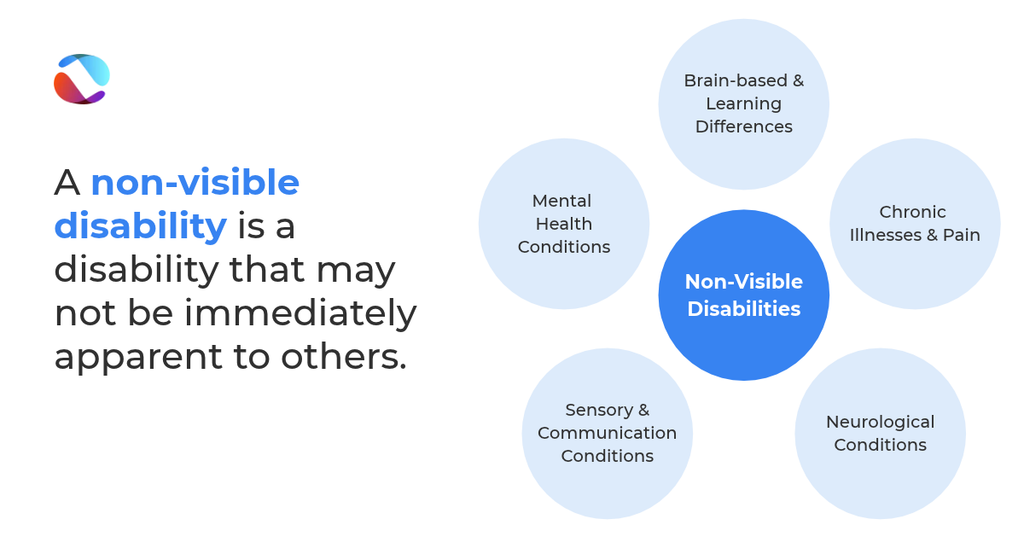
Since there is no single universally accepted definition of a non-visible disability, it is difficult to establish a reliable percentage of people who experience them.
Statistics Canada reported that 27% of Canadians aged 15 and older had at least one disability in 2022. This figure includes disabilities that may be visible, non-visible, or both, and cannot tell us precisely how many Canadians experience non-visible disabilities.
It is likely that non-visible disabilities are more common than we realize, but what matters is recognizing that we cannot determine how common disability is simply by looking around us.
One of the greatest challenges of non-visible disabilities is that people’s experiences may be misunderstood, questioned, or dismissed.
Traditional approaches to disability support place much of the responsibility on the individual. Asking for support can require disclosing personal information, identifying or proving a disability, describing areas of difficulty, or repeatedly explaining why something is hard. Sometimes, people are expected to demonstrate that they are struggling enough before flexibility or support feels justified.
Consider someone with ADHD. They may appear organized, attentive, and productive, but underneath, they invest significant mental effort in managing their attention, remembering information, initiating tasks, or keeping track of time.
They may complete a task one day and struggle with the same task another day. They may participate successfully in one environment but encounter significant barriers in another. This variability does not make their experience less valid.
Furthermore, capability and accessibility are not the same thing. Someone may be capable of completing a task while still needing support, flexibility, or accommodations to do so without unreasonable effort or harm to their well-being. Recognizing this distinction helps shift our attention from questioning someone’s capabilities to understanding the conditions that support their participation.
The relationship between neurodivergence and disability is personal and complex.
Neurodiversity refers to the natural variation that exists across human brains. Just as people differ in their physical characteristics, people also differ in how they think, learn, communicate, process information, and experience the world.
Neurodivergence refers to neurological development or functioning that differs from what is typically considered neurotypical. This includes experiences associated with autism, ADHD, dyslexia, and other learning or brain-based differences.
Some neurodivergent people identify as disabled. They may experience substantial barriers in education, employment, communication, or daily life, and find disability identity meaningful. Other neurodivergent people may not identify as disabled depending on their experiences. Both perspectives can coexist.
We do not need to deny disability to affirm neurodivergence, and we do not need to view neurodivergence as a deficit to recognize disability.
Language influences how we understand and respond to disability.
In British Columbia, the Accessible British Columbia Act defines disability as an “inability to participate fully and equally in society as a result of the interaction of an impairment and a barrier.”
This definition recognizes that environmental and systemic barriers shape disability.
At the same time, its emphasis on impairment and inability reflects limitations in language commonly used in legal and institutional contexts.
Legal definitions serve important purposes. However, they do not capture the full range of ways people understand and describe lived experiences.
Disability can be understood through multiple perspectives. For some, it is an important part of their identity and community. For others, it may primarily describe the barriers they encounter or serve as a legal or medical classification. These perspectives are not necessarily contradictory.
Recognizing disability-related barriers invites us to consider how environments, expectations, and systems can either enable or restrict participation.
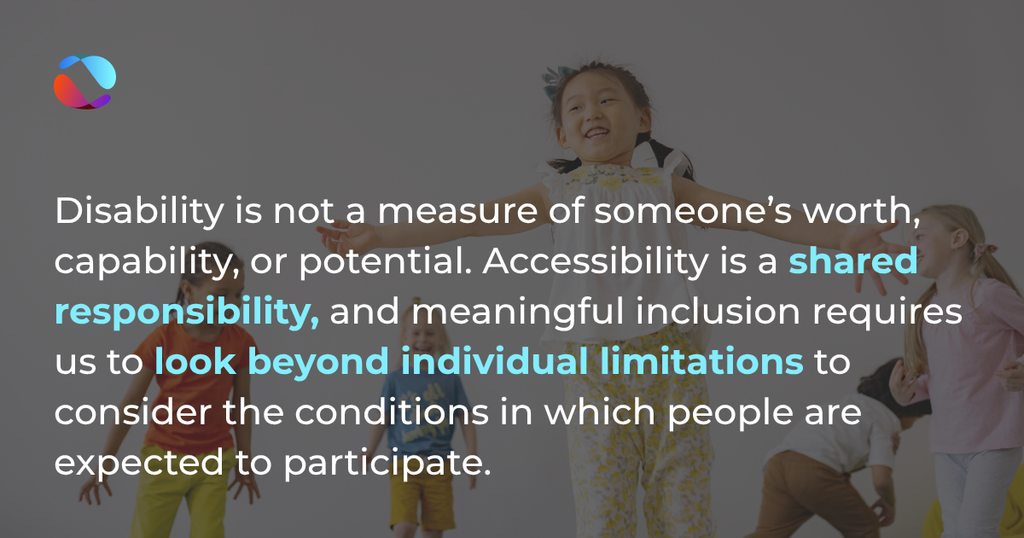
Disability is not a measure of someone’s worth, capability, or potential. Accessibility is a shared responsibility, and meaningful inclusion requires us to look beyond individual limitations to consider the conditions in which people are expected to participate.
As conversations about neurodiversity and accessibility evolve, we increasingly recognize that language focused on limitations does not fully capture people’s experiences.
Terms such as “learning difference” and “brain-based difference” recognize human variation without framing differences as deficiencies.
However, recognizing difference does not mean denying disability.
For some people, disability is an important part of their identity, community, and lived experience. Disability language can also communicate the significance of the barriers people encounter and reinforce their right to accessibility. For others, language centred on difference feels more accurate, meaningful, and affirming. Both perspectives are valid.
What matters is recognizing that people have the right to understand and describe their own experiences, and that our language should not diminish those experiences or create additional barriers.
The goal is to challenge the assumption that being different means being deficient.
A difference does not need to be viewed as a deficit to deserve understanding, accessibility, or accommodation.
An affirming approach recognizes that human differences are a natural part of society while acknowledging that people may encounter significant barriers and require support.
This perspective encourages us to consider whether expectations, environments, or systems have been designed with different needs and experiences in mind.
A neuroaffirming approach applies these principles to neurological differences, recognizing neurodivergence as part of human diversity rather than something that needs correction.
Meaningful allyship extends beyond awareness and involves changing how we respond to differences and how we design the environments around us.
For parents, caregivers, educators, employers, and community members, everyday interactions provide opportunities to model compassion, curiosity, and respect.
Here are some actions you can take:
Someone who looks comfortable may be working very hard to appear or feel that way.
Approach people’s experiences with curiosity. Do not make assumptions based on appearance, behaviour, or perceived capability.
We can encourage respectful questions while remembering that people are entitled to privacy. We do not need to know someone’s diagnosis to treat them with respect.
Statements such as “you did it yesterday” or “that should not be hard” can feel dismissive.
A person’s capacity can change depending on their environment, energy, health, and many other factors.
Instead, consider asking what is making something difficult and whether another approach might help.
People engage in different ways.
Some people need movement to concentrate. Others prefer written instructions, additional processing time, quiet environments, or alternative ways to communicate.
Rather than expecting everyone to participate in the same way, focus on the purpose of an activity and offer flexibility in how people engage.
Meaningful participation does not have to look the same for everyone.
Avoid using disability-related terms as insults or describing accommodations as unfair advantages. (Fairness is not always about everyone receiving identical support, but about everyone having meaningful opportunities to participate.)
Respect how people choose to describe themselves.
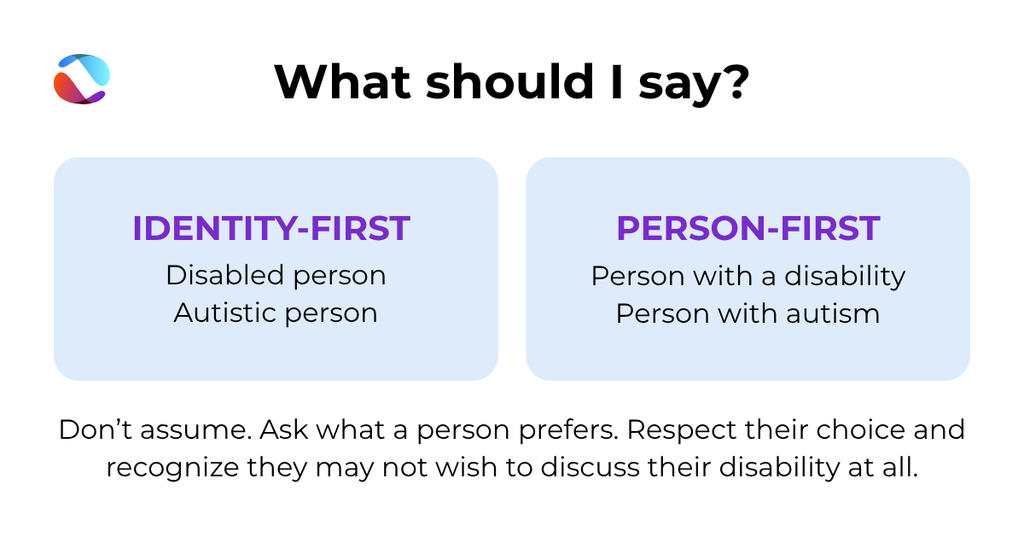
Some people prefer identity-first language, such as “disabled person” or “autistic person,” because disability or neurodivergence is an important part of who they are.
Others prefer person-first language, such as “person with a disability,” because they want to emphasize that disability is one aspect of their experience.
Neither preference should be assumed. When appropriate, ask someone how they prefer to describe themselves, respect their choice, and recognize that they may not wish to discuss their disability at all.
Offer choices, communicate expectations clearly, allow flexibility, and reduce unnecessary barriers whenever possible.
Accessibility should not require someone to disclose a diagnosis, provide personal medical information, or show they are struggling.
For example, providing written instructions alongside verbal explanations, offering quiet spaces, allowing movement breaks, or giving advance notice of changes can support many people without requiring anyone to explain why they need those options.
When accessible practices become part of the environment, people are less likely to need to disclose personal information.
Understanding non-visible disabilities means recognizing that we never have the full picture of someone else’s experience.
But we can choose how we respond.
We can listen without demanding explanations, approach differences with curiosity rather than judgment, and create environments that offer flexibility before someone reaches crisis.
When we make room for different ways of thinking, learning, communicating, and being, we can create more meaningful opportunities for everyone to participate.
Also, check out the Sunflower Lanyard, an internationally recognized symbol that lets someone discreetly communicate their disability. This program is recognized in various public spaces, including the Vancouver International Airport.
– By Becky Bishop, Senior Manager, Youth and Adult Programs
Receive our bi-weekly Arise newseltter which includes resources, updates, stories, events, and more.
Executive functioning refers to mental skills that help us focus, manage, adapt, control responses, and work toward a goal.
Learn More
If your child needs extra support at school, you may hear terms such as Student Learning Plan (SLP) or Individual Education Plan (IEP). Here are the basics BC parents should know.
Learn More
English Language Learning, commonly called ELL, refers to supports and services for students who are developing the English-language skills needed to participate successfully in school.
Learn More